- Home
- About Us
- Products
- Plastic Stirring Dryer
- Weighing Baler
- Plastic Crusher
- Waste Shredder Recycling Machine
- Industrial Chiller
- Mold Temperature Machine
- Feeding Conveyor
- Plastic Dryer Machine
- Screening Machine
- Film Granulator
- Other Plastic Auxiliary Equipment
- Extrusion Granulation Automation System
- Complete Automation System for Injection Molding
- Cases
- News
- Download
- Send Inquiry
- Contact Us

25,000 shredder vs 60,000 shredder: Why cheaper costs more in the long run
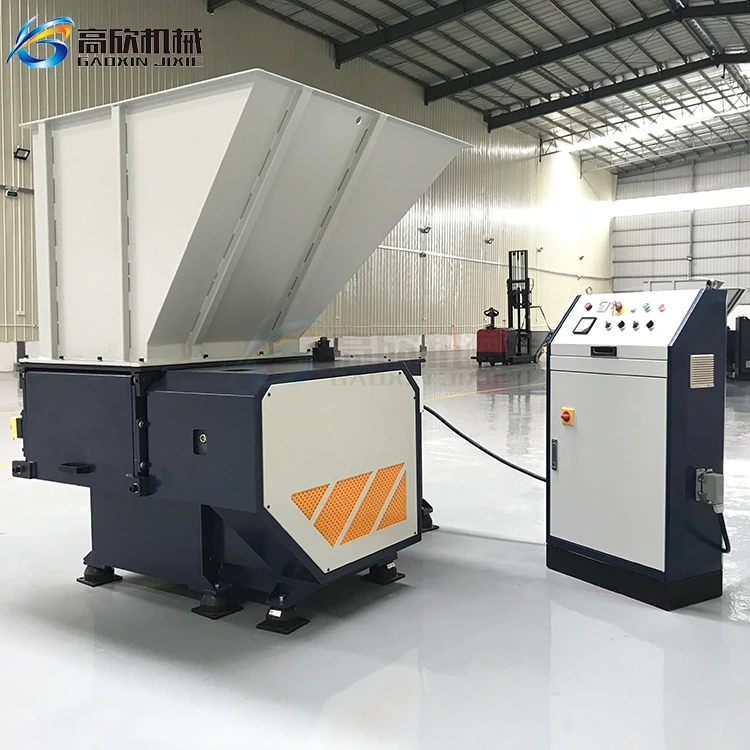
Selecting a waste shredder recycling machine involves more than just buying equipment that "shreds plastic." The right machine must match material type, throughput requirements, output particle size, rotor configuration, screen aperture, and upstream/downstream integration, while also accounting for energy consumption, noise levels, dust control, maintenance accessibility, and total cost of ownership. This article explains how shredder-recyclers differ from conventional crushers, how to verify fitment for your specific plastic waste stream, and which measurements matter before purchasing or installing. You'll also see the main safety checks that help prevent rotor jamming, blade fracture, bearing overheating, and discharge clogging — so the rest of the guide can focus on informed selection and proper operation.
Why Waste Shredder Recycling Machines Matter
Waste shredder recycling machines are critical process equipment designed to convert bulky plastic waste into uniform regrind for downstream washing, pelletizing, or compounding. By physically shearing large‑format scrap — such as appliance housings, chemical drums, pallets, pipes, and film bales — into controlled particle sizes, these machines directly determine the efficiency, energy footprint, and output quality of the entire recycling line.
Effects on throughput and regrind quality
The core parameters of a shredder — rotor diameter and length, number of cutting knives, spindle speed, and screen aperture — collectively define its processing capacity and particle size distribution. Taking Gaoxin Machinery's 600–1400 series as an example, rotor length increases from 600mm to 1400mm, corresponding to throughput ranging from approximately 500 kg/h (processing rigid ABS appliance scrap) to over 2,500 kg/h (processing HDPE drums). Knife count scales from 23+4 blades on the 600 model to 70+4 blades on the 1400 model. Higher blade density produces thinner chip layers per cut, improving particle uniformity and keeping fines (particles under 3mm) below 15%. Machines with low‑density rotor configurations often exceed 30% fines, which leads to frequent screen pack changes on pelletizing lines — shortening filter life from a normal 8 hours to as little as 2–3 hours, with significant downtime and consumable cost penalties.
Use cases across different plastic waste streams
Different plastic waste types impose vastly different demands on shredder configuration:
Rigid plastics (ABS, HIPS, PC, rigid PP) – These materials are brittle with moderate impact strength. Wear resistance on the cutting edge is critical, but torque requirements are moderate. Gaoxin's 800 model and above, equipped with 385–395mm rotor diameter and 35+4 to 70+4 blades, effectively avoids over‑size reduction, producing flake‑like particles that are ideal for subsequent friction washing and density separation.
Elastomeric / tough plastics (PE film, PP woven bags, PET bottles) – Tough materials tend to wrap around the rotor or form elongated strips, demanding excellent anti‑wrapping capability. Gaoxin's entire series is equipped with a hydraulic wave‑type feed rammer (wave pressure power ranging from 1.5kW to 5.5kW), which continuously forces material into the cutting zone and prevents bridging in the hopper. The gap between stationary and rotating knives is held to 0.3–0.5mm, ensuring clean shearing rather than tearing.
Hollow products (IBC totes, oil containers, fuel tanks) – Hollow products tend to "crush and spring back," reducing feed efficiency. Gaoxin's large hopper volume (up to 2,430L on the 1400 model) combined with long cylinder stroke (500–800mm) pre‑compresses hollow items before shearing, ensuring positive engagement with the rotor.
Engineering plastics (nylon + glass fiber, POM, PBT) – Glass‑filled engineering plastics are highly abrasive to cutting edges. Standard tool steel blades may dull within 20–40 operating hours. Gaoxin offers a wear‑resistant upgraded configuration: blades hard‑faced with tungsten carbide, chamber lined with abrasion‑resistant steel, and screens cast from high‑chromium iron. This extends blade life to 150–200 hours.
Key Specifications of Waste Shredder Recycling Machines
The structural integrity and compatibility of a shredder recycling machine depend entirely on precise dimensional specifications and material properties. Because these components endure immense shear forces and cyclic impact stresses, relying on approximate measurements rather than verified engineering data is non‑negotiable for safe, continuous operation.
Inlet size, rotor diameter & length, screen aperture, and main power
The four fundamental dimensions of any shredder are inlet size (D × F), rotor diameter and length, screen aperture, and main drive power.
Inlet size determines the maximum scrap dimensions the machine can accept. Gaoxin's 600 model features a 1,210×1,210mm inlet, suitable for typical appliance housings and medium‑sized drums. The 1400 model increases inlet size to 1,420×2,100mm, allowing direct feeding of shredded automotive bumpers, large pallets, and intact IBC totes — eliminating pre‑cutting labor and upstream equipment.
Rotor diameter and length directly correlate with shear torque and working width. Larger rotor diameter (225–395mm across Gaoxin's range) increases rotational inertia, improving the machine's ability to resist impact loads from thick‑walled scrap (e.g., HDPE sheet over 10mm) without stalling. Rotor length (600–1,400mm) defines coverage across the hopper width; for film bales or woven bag bales, a long rotor processes the entire bale width in one pass, avoiding unsheared material at the edges.
Screen aperture controls the theoretical maximum particle size exiting the cutting chamber. Gaoxin's standard configuration uses a 40mm round-hole screen, producing particles between 20–50mm — suitable for direct feeding into pelletizers or friction washers. Custom apertures from 12mm to 80mm are available: 12–15mm for fine feed to single‑screw extruders; 25–30mm for general recycling; 50–80mm for pre‑shredding applications followed by a secondary granulator.
Main power defines the machine's energy input ceiling and practical throughput. Gaoxin's series spans 18.5kW (600 model) to 75kW (1400 model). Power and throughput do not scale linearly: moving from the 45kW (1000 model) to the 55kW (1200 model) represents a 22% power increase, but rotor length increases by 200mm and blade count increases by 10 knives — delivering a throughput gain of 35–40%. This demonstrates that optimizing blade density and rotor length is often more effective than simply increasing motor power.
Knife material, machining tolerances, and heat treatment
High‑quality shredders depend on knife material, machining precision, and heat treatment as interdependent pillars.
Knife material – Gaoxin uses Cr12MoV tool steel or higher‑grade DC53 powder metallurgy steel for both rotating and stationary knives. Cr12MoV offers good wear resistance and hardenability, achieving Rockwell hardness (HRC) of 58–62 — suitable for general plastic recycling. DC53 maintains high hardness while providing superior toughness (HRC 60–63), making it ideal for glass‑filled scrap or applications with impact loads, significantly reducing the risk of chipping.
Machining tolerances – Premium manufacturers maintain runout tolerances of ±0.02mm on rotor shaft and mounting flanges. This prevents high‑speed vibration that would otherwise accelerate bearing wear and cause premature knife contact. All Gaoxin rotors are dynamically balanced to ISO 1940 G6.3 standards.
Heat treatment – Knives undergo vacuum heat treatment followed by sub‑zero tempering to convert retained austenite and relieve internal stresses. This produces a uniform microstructure that resists micro‑cracking under impact. Surface hardness depth is controlled to 1.5–2.0mm, ensuring a hard wear layer backed by a tough core.
Single‑shaft vs. two‑stage shredder comparison
The choice between a single‑shaft shredder and a two‑stage shredder‑granulator combination depends on target output size and throughput consistency.
| Specification | Single‑shaft Shredder | Two‑stage (Shredder + Granulator) |
|---|---|---|
| Typical Output Size | 20–50mm (with 40mm screen) | 6–12mm (second stage) |
| Rotor Speed | Low‑speed, high‑torque (80 rpm) | First stage 80 rpm; second stage 280–450 rpm |
| Fines Generation | Low (fines <15%) | Higher (fines can exceed 25%) |
| Energy per Ton | Lower (≈42–48 kWh/ton) | Higher (+30–40%) |
| Best Applications | Direct feed to pelletizer / wash line | Closed‑loop injection molding regrind; high‑quality film recycling |
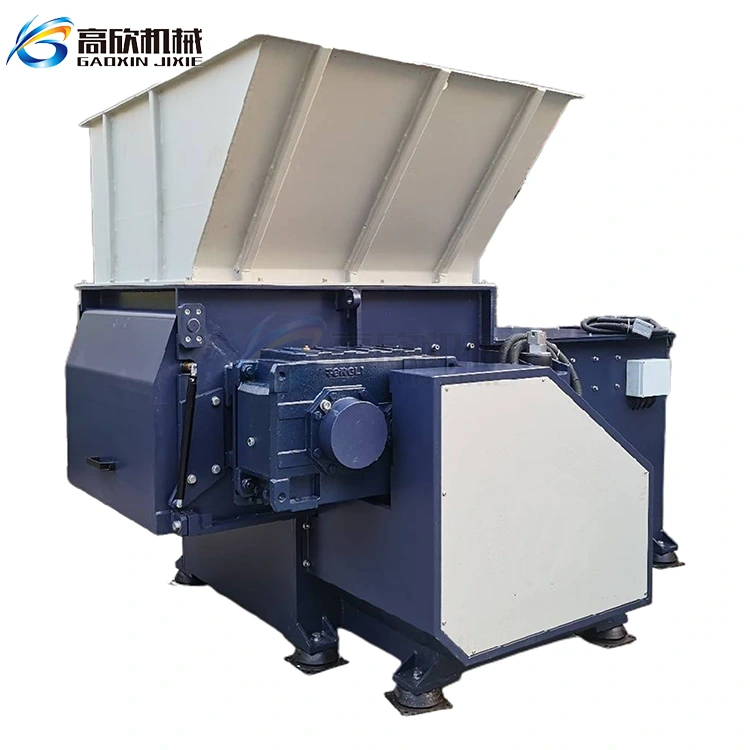
Gaoxin's 600–1400 series are single‑shaft low‑speed shredders, optimized for applications where energy efficiency, low dust, and direct downstream integration are priorities.
Installation and Fitment Evaluation
Proper installation protocols and rigorous fitment evaluations are paramount when integrating a shredder into a recycling line. Failures in this domain rarely result from material defects; rather, they stem from improper torque application on mounting bolts, inadequate feed control, or misaligned discharge interfaces.
Pre‑installation checks
Before installation, technicians must thoroughly clean the machine mounting foundation and verify floor flatness within 0.5mm/m using a machinist's level. The most critical pre‑installation check involves verifying electrical supply compatibility: main motor amperage, voltage (typically 380–415V / 50Hz or 460V / 60Hz), and control circuit wiring must match the machine's nameplate. For hydraulic rammer systems, hydraulic oil grade (ISO VG 46 or 68) and system cleanliness (NAS Class 9 or better) must be confirmed.
Common risks: jamming, blade fracture, overheating, clogging
Improper fitment or operation introduces several severe risks:
Rotor jamming occurs when unshreddable contaminants (metal parts, stones, hard rubber) enter the cutting chamber. Gaoxin's control system includes a dynamic load adaptive algorithm: when main motor current exceeds 150% of rated current for more than 2 seconds, the controller automatically reverses rotor direction for 3–5 seconds to eject the contaminant before resuming forward rotation. Operators must be trained to clear a jammed rotor only after electrical lockout/tagout.
Blade fracture typically results from attempting to shred materials exceeding the machine's design limits (e.g., steel‑reinforced plastic or concrete‑filled drums). The standard solution is installing a tramp metal detector on the infeed conveyor, programmed to stop the feed belt immediately upon detection.
Bearing overheating is often caused by improper lubrication or seal damage. Gaoxin specifies high‑temperature lithium grease (NLGI Grade 2) applied every 200 operating hours. Bearing housing temperature should never exceed 80°C; temperatures above this threshold require immediate shutdown and inspection.
Screen clogging happens when processing high‑moisture content scrap (unwashed film containing organics) or materials with low melting points (e.g., PS foam). The recommended solution is pre‑drying or pre‑washing the feed, along with periodic screen cleaning using compressed air.
Regulations, environmental compliance, and liability considerations
Regulatory compliance significantly influences the legality and operating permit of shredder installations. In many jurisdictions, such as under China's GB 16297‑2023 air emission standards, shredders must be equipped with enclosed dust extraction systems maintaining workplace dust concentration below 2 mg/m³. In European markets, CE certification requires compliance with the Machinery Directive 2006/42/EC and noise emission limits under EN 12096. Gaoxin machines are available with full enclosure, negative‑pressure dust collection, and sound‑absorbing panels (target noise ≤85 dB(A) at 1 meter). Fleet operators and recycling plant managers must also weigh liability considerations: unauthorized modifications to safety guards or removal of interlocks can void equipment warranties and expose operators to regulatory fines.
Sourcing, Quality, and Cost
Sourcing waste shredder recycling machines requires evaluating manufacturing origin, quality control processes, and the balance between capital expenditure and structural reliability. Given the safety‑critical nature of the equipment, procurement managers must prioritize supplier transparency and verified metallurgical data.
How to assess supplier capability
Assessing supplier capability begins with verifying ISO 9001:2015 certification and requesting documented material test reports (MTRs) for key components (rotor shaft steel, blade alloy, bearing brand and grade). Capable suppliers operate multi‑axis CNC machining centers and use coordinate measuring machines (CMM) to validate runout tolerances of ±0.02mm. Furthermore, buyers should request documentation on knife hardness (HRC readings from at least three locations per knife) and dynamic balance reports for the rotor assembly.
MOQ, lead time, private labeling, and sales channels
In B2B capital equipment procurement, Minimum Order Quantities (MOQs) for standard shredder models typically are 1–2 units. For custom‑engineered configurations (e.g., explosion‑proof design, stainless steel contact parts for food‑grade recycling), lead times generally span 30–45 working days from order confirmation to factory acceptance testing. For distributors, private labeling is common practice, with suppliers offering custom paint colors, brand nameplates, and serial number tracking. Sales channels are predominantly segmented into direct‑to‑end‑user equipment sales, turnkey recycling line integrators, and specialized plastics machinery distributors.
Price vs. quality comparison
The market for shredder recycling machines is highly stratified by price and corresponding quality. Budget‑tier products often sacrifice material integrity and precision, leading to severe safety risks, whereas premium tiers invest heavily in certified components and engineered reliability.
| Market Tier | Price Range (USD) | Material & Manufacturing | Key Characteristics |
|---|---|---|---|
| Entry‑Level | 8,000–8,000–15,000 | Mild steel fabrication, unknown blade alloy | High vibration, short blade life (<100 hrs), no overload protection. High downtime risk. |
| Mid‑Range | 18,000–18,000–35,000 | 6061 aluminum or structural steel, Cr12MoV blades | Basic electrics, manual hydraulic rammer. Suitable for intermittent operation. |
| Premium / Industrial | 40,000–40,000–85,000+ | Hardox chamber liners, DC53 or D2 blades, premium bearings (SKF/FAG) | Full PLC control, auto reverse, anti‑jam, hub‑centric knife mounting, load adaptive. 24/7 rated. |
Gaoxin Machinery positions itself in the premium/industrial tier, with all 600–1400 series machines built to 24/7 continuous operation standards.
Selection Framework for Waste Shredder Recycling Machines
Implementing a rigorous selection framework ensures that the chosen shredder meets the mechanical requirements of the recycling stream without compromising safety margins. A systematic approach prevents costly fitment errors and mitigates premature wear on downstream equipment.
Step‑by‑step product selection process
The selection process follows a strict sequential order:
Step 1 – Characterize the waste stream
Identify plastic type(s), maximum feed dimensions, bulk density, moisture content, and estimated throughput (kg/h or tons/shift). If contaminants (metal, rubber, wood) exceed 2% by weight, a pre‑sorting stage or tramp metal detector is required.
Step 2 – Determine required output particle size
- 6–12mm: Direct injection molding regrind → requires two‑stage system (shredder + granulator)
- 20–40mm: Feed to single‑screw pelletizer or wash line → single‑stage shredder with 40mm screen
- 50–80mm: Pre‑shredding before secondary granulation → single‑stage shredder with large screen
Step 3 – Match inlet size to largest scrap dimension
As a rule of thumb, the shorter inlet dimension (D or F) must be ≥ 1.5× the longest scrap dimension. For intact IBC totes (1,200×1,000×1,150mm), the 1400 model (1,420×2,100mm inlet) is required.
Step 4 – Calculate rotor torque requirement
For tough materials (film, woven bags), rotor diameter must be ≥ 300mm to generate sufficient inertia. Gaoxin's 385–395mm rotors on 800–1400 models provide 3,800–4,500 Nm of torque.
Step 5 – Verify power and electrical infrastructure
Confirm available main breaker capacity, transformer rating, and cable gauge. A 75kW machine drawing full load current (≈140A at 380V) requires a 200A branch circuit.
Step 6 – Specify add‑ons
- Hydraulic rammer (included on all Gaoxin 600–1400 models) – mandatory for hollow or low‑bulk‑density materials
- Dust extraction enclosure – mandatory for indoor installations in regulated jurisdictions
- Automatic lubrication system – recommended for 24/7 operations
- Spare knife set and screen – recommended for minimum 200 hours of continuous operation
Balancing performance, compliance, and budget
Balancing performance against compliance and budget constraints requires evaluating total cost of ownership (TCO) over a 5‑year horizon. While a premium industrial shredder may cost 60,000��.60,000vs.25,000 for an entry‑level machine, the total cost comparison typically shows:
| Cost Component | Entry‑Level | Premium (e.g., Gaoxin 1200) |
|---|---|---|
| Initial Purchase | $25,000 | $60,000 |
| Blade Replacements (5 years, 10,000 hrs) | 10 sets @ 800=800=8,000 | 4 sets @ 1,500=1,500=6,000 |
| Bearing Replacements | 3 times @ 600=600=1,800 | 0–1 times @ 800=800=800 |
| Downtime Cost (10,000 hrs at $100/hr lost production) | 500 hrs downtime = $50,000 | 100 hrs downtime = $10,000 |
| 5‑Year TCO | $84,800 | $76,800 |
The premium machine delivers lower total cost despite higher upfront investment, primarily through reduced downtime and longer component life. Procurement managers and plant operators alike must weigh the initial capital outlay against the long‑term savings realized by avoiding production interruptions and mitigating safety risks associated with substandard equipment. Ultimately, prioritizing certified materials, documented tolerances, and rugged design ensures that the operational benefits of a waste shredder recycling machine are fully realized without compromising plant safety or output quality.
Key Takeaways
- Choose by waste type first, then by throughput – Rigid plastics, tough films, hollow products, and engineering plastics each demand different rotor, knife, and power configurations. Matching the machine to the material is non‑negotiable.
- Four core specs must align – Inlet size, rotor diameter/length, screen aperture, and main power. Changing any one after purchase is expensive or impossible.
- Installation discipline prevents failures – Verify foundation flatness, electrical compatibility, and hydraulic cleanliness before first start. Re‑torque mounting bolts after the first 50 operating hours.
- Safety systems are not optional – Auto‑reverse on overload, tramp metal detection, and guarded electrical interlocks protect both the operator and the equipment.
- Compliance drives permits – Dust control (<2 mg/m³), noise (<85 dB(A) where required), and CE or local machinery certification are prerequisites for regulated facilities.
Frequently Asked Questions
What is the difference between a single‑shaft shredder and a two‑stage shredder‑granulator?
A single‑shaft shredder (like Gaoxin's 600–1400 series) operates at low speed (80 rpm) with high torque, producing particles typically 20–50mm in size. It is energy‑efficient, generates low dust, and is ideal for feeding directly into pelletizers or wash lines. A two‑stage system adds a high‑speed granulator after the shredder, producing finer particles (6–12mm) at the cost of higher energy consumption (+30–40%) and more fines.
How do I choose the correct shredder size for my recycling line?
Match four specifications exactly: required throughput (kg/h), maximum feed dimension (mm), target output particle size (mm), and plastic type (rigid, tough, hollow, or filled). Then confirm available electrical power (kW), floor space, and downstream equipment compatibility before ordering. Use Step 1–6 in the Selection Framework above.
When should I use a hydraulic rammer vs. gravity feed?
Use a hydraulic rammer (standard on all Gaoxin 600–1400 models) for hollow products (drums, IBC totes), low‑bulk‑density materials (film, foam, fibers), or any feed that tends to bridge in the hopper. Gravity feed alone is sufficient only for free‑flowing, dense, rigid scrap (e.g., purgings, thick sheet, chunks).
Do shredder recycling machines affect downstream pelletizer performance?
Yes. Output particle size distribution directly impacts pelletizer throughput, energy consumption, and screen pack life. Uniform 20–40mm particles with low fines (<15%) maximize pelletizer efficiency. Overs (>50mm) can cause extruder bridging; overs can cause extruder bridging; fines (<3mm) accelerate screen pack blinding. Gaoxin's high blade density and 40mm screen are optimized to balance these factors.
What makes a waste shredder safe for daily industrial operation?
Choose a machine with: (1) heavy‑duty rotor dynamically balanced to ISO 1940 G6.3; (2) auto‑reverse overload protection; (3) safety interlocks on all access doors; (4) guarded belt drive or direct coupling; (5) documented blade metallurgy and hardness; (6) dust extraction interface designed to local regulations. Gaoxin's 600–1400 series includes all of these as standard on premium/industrial configurations.
Related News
- Smart Conveying, Empowering Efficient Production - Your Dedicated Screw Conveyor Solutions Expert
- Turning waste into treasure, turning stone into gold—opening a new era of profitability and green development for PET recycling.
- Vertical Plastic Mixers: Empowering Precision Mixing, Setting a New Benchmark in Intelligent Plastic Manufacturing
- Reclaim the value of your plastic waste with the Gaoxin Plastic Shredder—the ultimate solution for efficient recycling
- Weighing Baler: How It Works and Why It Matters for Modern Recycling Operations
- Waste Shredder Recycling Machine: A Practical Selection & Implementation Guide — From Principle to On-Site Solutions
Leave me a message